Commonplace
Lines worth keeping.
-
“Being ignorant is not so much a shame, as being unwilling to learn.”
Meaning. Not knowing something is no disgrace — everyone starts ignorant. The real fault is refusing to close the gap when you could.
Context. Quoted in education and growth-mindset writing as a line separating excusable ignorance from culpable stubbornness.
Origin. Attributed to Franklin, often to Poor Richard's Almanack, but no specific issue is documented; provenance is uncertain.
-
“Πάντα μοι ἔξεστιν, ἀλλ' οὐ πάντα συμφέρει· πάντα μοι ἔξεστιν, ἀλλ' οὐκ ἐγὼ ἐξουσιασθήσομαι ὑπό τινος.”
“All things are lawful for me, but not all are helpful; all things are lawful for me, but I will not be mastered by anything.”
“Все мне позволительно, но не все полезно; все мне позволительно, но ничто не должно обладать мною.”
Meaning. Permission is not wisdom. Freedom to do something doesn't mean it serves you, and what you indulge can quietly become your master.
Context. Quoted in Christian ethics, addiction recovery, and Stoic-adjacent self-mastery writing. Paul's split between license and dependency reads as a precursor to modern habit theory.
Origin. Paul's First Letter to the Corinthians (1 Cor 6:12), written from Ephesus around 53–54 CE. Addressed to a young Greek congregation wrestling with libertine Christian freedom.
-
“Die Summe der in der ganzen Natur vorhandenen Kraft bleibt unverändert, es kann keine Kraft aus nichts entstehen, ebenso wenig wie irgendeine Kraft vernichtet werden kann.”
“The sum of force present in all of nature remains unchanged; no force can arise from nothing, just as no force can be destroyed.”
Meaning. The total energy in nature is conserved — none created from nothing, none destroyed. The phrasing predates the modern term "energy"; Kraft was the working word in 1847.
Context. One of the first clean statements of energy conservation. Quoted in physics, philosophy of science, and history-of-science writing as the moment the principle entered formal discourse.
Origin. Helmholtz's 1847 lecture "Über die Erhaltung der Kraft," delivered to the Physikalische Gesellschaft in Berlin and published the same year as a small monograph.
-
“Education is not the learning of facts, but the training of the mind to think.”
Meaning. Real education isn't accumulating information — it's developing the cognitive habits that let you generate, evaluate, and revise thought independent of any specific content.
Context. Quoted in education-reform, autodidact, and lifelong-learning writing as the canonical argument against content-stuffing pedagogy. Used to justify everything from Montessori to curriculum cuts.
Origin. Loosely attributed to Einstein. A fuller version appears in a 1921 Boston Herald interview defending liberal-arts colleges; the compressed form circulating today is a later paraphrase.
-
“The test of a first-rate intelligence is the ability to hold two opposed ideas in the mind at the same time, and still retain the ability to function.”
Meaning. Real cognitive capacity is not picking the right side of a tension but inhabiting both sides without paralysis. Strength is measured by the contradiction one can carry.
Context. Quoted in psychology, leadership, and complexity writing — a one-line standard for sophisticated thought. Often cited alongside Hegel and Keats's "negative capability."
Origin. From Fitzgerald's 1936 Esquire essay "The Crack-Up," a public account of his breakdown. Collected in Edmund Wilson's 1945 volume of the same name.
-
“Chance is perhaps the pseudonym of God when he does not want to sign.”
Meaning. What looks like coincidence may be intentional concealment. Providence and randomness as the same actor in different costumes.
Context. Quoted in writing on luck, providence, and theology — especially where the author wants to leave the metaphysical question open without committing to a side.
Origin. Attributed to the French Romantic poet and critic Théophile Gautier. The exact work is not consistently cited; the line circulates as a free-standing aphorism.
-
“The fundamental cause of the trouble is that in the modern world the stupid are cocksure while the intelligent are full of doubt.”
Meaning. Confidence and competence are inversely correlated in public life — the loudest certainty usually comes from the worst-equipped, while those who could speak well hesitate.
Context. A founding line for what later got named the Dunning–Kruger effect. Quoted in politics, media, and epistemics writing as the canonical diagnosis of confident ignorance.
Origin. Russell's 1933 essay "The Triumph of Stupidity," written shortly after Hitler's rise. Collected in Mortals and Others Vol. 2.
-
“Always code as if the guy who ends up maintaining your code will be a violent psychopath who knows where you live.”
Meaning. Write code as if the person who has to maintain it later will be dangerously hostile and well-informed about where you sleep.
Context. Programmer folklore canon. Quoted in code-review, style-guide, and onboarding contexts as the comic case for clarity, comments, and not being clever.
Origin. John F. Woods, Usenet post to comp.lang.c++ (February 1991). Frequently misattributed to Martin Golding or other programmers.
-
“We should forget about small efficiencies, say about 97% of the time: premature optimization is the root of all evil. Yet we should not pass up our opportunities in that critical 3%.”
Meaning. Most optimization is wasted effort against unmeasured assumptions. The remaining 3% — the real hot path — deserves serious attention; the trick is telling them apart with data.
Context. The most-quoted line in software engineering, usually truncated to "premature optimization is the root of all evil" — which strips Knuth's 3% exception and inverts his actual point.
Origin. From Knuth's 1974 paper in Computing Surveys (Vol. 6, No. 4). Reprinted in his 1992 collection Literate Programming.
-
“What is necessary to change a person is to change his awareness of himself.”
Meaning. Behavior changes only when self-perception changes. External pressure to alter someone fails; the leverage point is how the person sees themselves.
Context. Foundational in humanistic psychology, therapy, and coaching. Quoted as the argument against behavior modification without insight — change the mirror, not the action.
Origin. Attributed to Maslow's humanistic writings (Motivation and Personality, Toward a Psychology of Being). No specific page is consistently cited; circulates as part of his broader framework.
-
“I suppose it is tempting, if the only tool you have is a hammer, to treat everything as if it were a nail.”
Meaning. Tools shape perception. With only one method available, every problem begins to look like the problem that method already solves.
Context. Quoted across psychology, methodology, software, and management writing — the canonical line about cognitive overfitting to one's toolkit. Sometimes called "Maslow's hammer."
Origin. From Maslow's The Psychology of Science (1966), not the more famous Toward a Psychology of Being (1962) where it is widely misattributed.
-
“In regione caecorum rex est luscus.”
“In the country of the blind, the one-eyed man is king.”
Meaning. Mediocrity becomes excellence when the surrounding standard collapses. Modest competence reads as mastery in a context with no real comparison.
Context. Quoted across leadership, expertise, and politics writing — often to deflate self-congratulation by pointing at the impoverished comparison set rather than the achievement.
Origin. From Erasmus's Adagia (1500, expanded over his life), a vast collection of Greek and Latin proverbs. The Latin line predates him; he canonized its circulation in Europe.
-
“Sometimes it happens that a man's circle of horizon becomes smaller and smaller, and as the radius approaches zero it concentrates on one point. And then that becomes his point of view.”
Meaning. As a person's perspective narrows it eventually collapses to a single point, which they then mistake for objective reality. Wit on dogmatism and tunnel vision.
Context. Quoted in mathematics, philosophy, and ideas-writing as a one-line takedown of ideological narrowing. Especially loved for its geometric metaphor turned moral.
Origin. Spoken, not written. Preserved in Constance Reid's biography Hilbert (1970), drawn from anecdotes of his Göttingen students and colleagues.
-
“Experience is something you don't get until just after you need it.”
Meaning. Wisdom arrives too late to prevent the mistake that produced it. The lesson and the cost can't be separated.
Context. Quoted in software engineering, design, and project-management cultures as the canonical line about hindsight and the inevitability of rework.
Origin. From Wright's stand-up catalog of deadpan one-liners. No specific album or special is universally cited; the line circulates as part of his routines.
-
“Don't worry about failures, worry about the chances you miss when you don't even try.”
Meaning. The cost of inaction outweighs the cost of failed action. Failed attempts at least produce information; untried chances produce nothing.
Context. Self-help and entrepreneurship canon. Quoted as a reframe of risk — the asymmetry between the felt weight of failure and the silent loss of opportunity.
Origin. Attributed to the Chicken Soup for the Soul series, co-created by Canfield and Mark Victor Hansen from 1993 onward. Specific volume and page not commonly cited.
-
“Everything you want is on the other side of fear.”
Meaning. The thing you most want sits behind the thing you most fear. Acting through fear is the actual price of acquisition — not skill, not luck.
Context. Self-help canon. Quoted in motivational, entrepreneurial, and therapeutic settings as a one-line argument against avoidance, especially the kind disguised as "waiting for the right moment."
Origin. Universally attributed to Canfield, co-creator of Chicken Soup for the Soul. The exact line doesn't trace to a specific book or talk — repetition hardened the attribution.
-
“Life may be not only meaningless but absurd.”
Meaning. Beyond mere meaninglessness, life may carry an active absurdity — the gap between the seriousness we bring to it and the cosmic indifference that meets us back.
Context. Quoted in philosophy-of-life and existentialist debates. Sits alongside Camus and Kierkegaard as a calmer, analytic take on the absurd — less anguish, more shrug.
Origin. From Nagel's 1987 primer, in the chapter on the meaning of life. Echoes his earlier 1971 essay "The Absurd" in The Journal of Philosophy.
-
“Whenever you feel like criticizing any one, just remember that all the people in this world haven't had the advantages that you've had.”
Meaning. Before judging anyone, remember the advantages — material, social, accidental — that you had and they didn't. Empathy as the precondition for fair assessment.
Context. Quoted as the bedrock of American liberal humility — privilege checked at the door. Invoked in conversations about class, race, and inherited opportunity.
Origin. Opens The Great Gatsby (1925) — Nick Carraway recalls his father's words "in younger and more vulnerable years." Not Fitzgerald speaking in his own voice.
-
“Cogito, ergo sum.”
Meaning. The act of doubting one's existence proves a thinker exists. Whatever else can be questioned, the doubting itself is undeniable.
Context. Cited as the bedrock of modern Western philosophy — the move that grounded knowledge in the subject rather than in received authority.
Origin. First stated as "Je pense, donc je suis" in Discourse on the Method (1637); the Latin form appeared in Principia Philosophiae (1644).
-
“Everything should be made as simple as possible, but not simpler.”
Meaning. Reduce everything you can, but stop short of breaking what the thing has to do. Simplification has a floor — the essential structure that lets the system still answer for itself.
Context. Quoted across science, design, software architecture, and writing as a rule against both over-engineering and over-simplification. Often paired with Occam's razor as the counterweight that keeps the razor from cutting too deep.
Origin. The exact phrasing does not appear in Einstein's writings. The closest verified ancestor is his 1933 Herbert Spencer Lecture, where he argued that theory should reduce its elements to the fewest possible "without having to surrender the adequate representation of a single datum of experience." Roger Sessions compressed this into the modern form in a 1950 New York Times article, and the line that circulates today is a further tightening of that paraphrase.
-
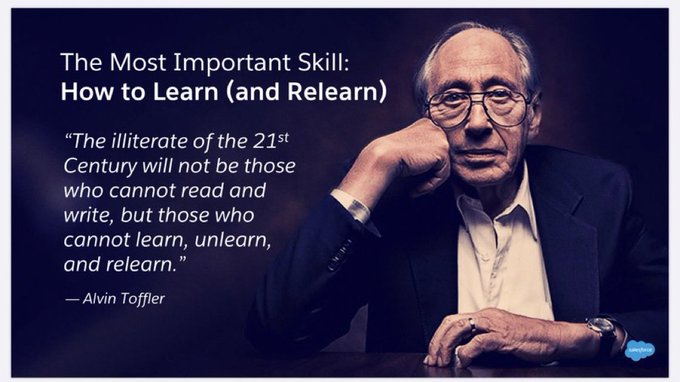
“The illiterate of the 21st century will not be those who cannot read and write, but those who cannot learn, unlearn, and relearn.”
Meaning. True ignorance in modern times is the inability to let go of old, obsolete knowledge (unlearn) and adopt new ways of thinking and working (relearn).
Context. Often cited to highlight the need for lifelong learning in response to rapid technological advancements and societal shifts.
Origin. Widely associated with Future Shock (1970), though the exact phrasing surfaces in later articles and discussions of Toffler's work on accelerating change.
-
“Talis profecto est haec humana libertas, quam omnes habere iactant, et quae in hoc solo consistit, quod homines sui appetitus sint conscii et causarum, a quibus determinantur, ignari.”
“Люди считают себя свободными только потому, что они сознают свои желания, но не знают причин, которыми они определяются.”
“Such indeed is that human freedom which all men boast of possessing, and which consists solely in this: that men are conscious of their desire and ignorant of the causes by which they are determined.”
Meaning. We mistake awareness of our wants for freedom. Feeling a desire is not the same as knowing why it arose — and it is the hidden causes, not the felt volition, that actually move us.
Context. A cornerstone of Spinoza's determinism, quoted across philosophy of mind, psychology, and free-will debates. Often read as an early anticipation of the unconscious: the sense of choosing masks the causal chain beneath it.
Origin. From Spinoza's Letter 58 to G. H. Schuller (1674), which answers a question about freedom with the image of a falling stone that, if conscious, would believe it fell of its own will. The same argument closes Part I of the Ethics (1677). Cited here in the standard Russian rendering of his selected works.